
Sourcing Token Changer Machines from a China Factory: Customization and Pre-Shipment Checklist
By Marketing Team
Buying token changer machines from a China factory goes smoothly when you confirm a few critical details in writing before production starts: currency, tokens, power, certifications and commercial terms. Then you check each machine against that written spec before it ships. This guide covers both steps from the factory side, based on the questions we work through with overseas distributors and arcade operators.
If you haven’t chosen a machine type yet, start with our guide on how to choose a token changer for your arcade.
Token Changer, Coin Changer or Kiosk?
A token changer takes cash and dispenses arcade tokens. A coin changer takes banknotes and dispenses coins as change. A self-service kiosk usually issues or tops up game cards instead of dispensing tokens.
The words often overlap in listings. “Coin changer” is sometimes used for machines that dispense tokens, so make sure your supplier knows exactly what your machine should pay out. Kubile builds token vending machines, a cash and coin exchange machine and self-service kiosks.
Before You Contact a Factory: Seven Inputs to Prepare
Have these ready before your first conversation. Most delays come from one of them being decided late.
- Destination market: the country where the machines will run.
- Currency and denominations: which notes and coins the machine must accept.
- Your tokens: diameter, thickness and material, ideally with physical samples.
- Payment methods: cash only, or also card, QR or a card-system reader.
- Quantity: per model and in total.
- Branding: cabinet color, stickers, logo, interface language.
- Delivery point: factory, Chinese port or your door. This decides the trade term (see below).
Customization Options and What Each One Changes
Most customization is straightforward, but each option can affect minimum order, lead time or certification.
At Kubile, cabinet colors, stickers, interface languages, payment modules and selected functions can be customized, and coin and token handling is configured to the required denomination, size and payout method.
| Option | What it changes | What to confirm |
|---|---|---|
| Cabinet color | Appearance | Color reference (e.g. RAL/Pantone) |
| Stickers and logo | Branding | Approved artwork file before production |
| Interface language | Screen text | Final text supplied or approved by you |
| Pricing and bonus rules | How many tokens per note | Price table in writing |
| Bill acceptor | Which notes are accepted | Brand, model and currency version |
| Coin/token acceptor and hopper | Which tokens are accepted and paid out | Token samples sent to the factory |
| Card or QR payment | Cashless options | Reader model and integration; may affect certification |
| Remote reporting (Wi-Fi/4G) | Remote data | Wireless modules may need extra certification in some markets |
Bill Acceptors: Currency Must Be Set Before Production
A bill acceptor is set up for one currency, and that currency must be specified before production.
Bill acceptors are configured per currency. With many brands, the currency code is even part of the model number. A machine built for US dollars won’t accept euros or ringgit without a different acceptor or software. Kubile’s token machines use a BTC-brand bill acceptor as standard, and Kubile can configure machines for any currency. Tell us your currency and denominations when you request a quote.
Two more points:
- New banknotes. When a country issues a new note, existing acceptors may need a software update or replacement. When Australia introduced its new $5 note in 2016, for example, some older acceptors couldn’t be upgraded. Ask how updates are handled after delivery.
- Euro area. The European Central Bank publishes a list of banknote authentication devices that have passed its tests. Euro-area buyers can check the acceptor model against it.
Tokens, Coin Acceptors and Hoppers
Send the factory physical samples of your tokens. It’s the single most effective way to avoid problems at installation.
Token diameter, thickness and material all affect how reliably the acceptor and hopper work. Samples let the factory set up and test the machine with your actual tokens. Also confirm hopper capacity, because it decides how often staff refill the machine. Kubile’s MZ-172, for example, holds 15,000 tokens.
Power, Plugs and Certifications by Market
A wide-voltage power supply solves voltage but not plugs or certification. Confirm both for your destination.
Kubile’s machines run on 110–240 V, so voltage is rarely an issue. Plug type and power cord should be specified for the destination country.
Certification depends on where the machines will be used:
| Market | What usually applies | Note |
|---|---|---|
| European Union | CE marking (Low Voltage and EMC directives), with technical file and declaration of conformity | Check RoHS requirements too |
| United Kingdom | UKCA, or CE marking, which the UK continues to recognise | Per UK government guidance |
| United States | FCC Part 15 for electronics; electrical safety certification by a recognised test lab is often required by venues or local authorities | Wireless modules need separate FCC certification |
| Australia / New Zealand | Electrical equipment registration (EESS) with a local responsible supplier, and the RCM mark | Requires a local registered entity |
| Saudi Arabia | SABER product certificate plus a certificate for each shipment | Arrange before shipping |
| Other markets | Confirm with your importer or customs broker | Requirements vary |
Kubile can provide CE certification; confirm it for your model when you request a quote. Whatever your supplier, ask for the certificate that covers your model before you order.
MOQ, Lead Time, Payment and Warranty: Get It in Writing
Agree on these four terms before you pay a deposit:
- Minimum order quantity: for standard and custom-branded machines. Kubile’s MOQ is one unit; if you’re customizing, confirm it for each option when you request the quote.
- Lead time: for standard and customized machines, including busy seasons. Kubile’s lead time is 7–28 days, depending on the order.
- Payment terms: deposit and balance, and when the balance is due. Kubile works on T/T: 50% deposit, balance before shipment.
- Warranty: length, what’s covered, and who pays for replacement parts and shipping. Kubile machines come with a one-year warranty.
Turn Your Requirements into a Spec Sheet and PI
Everything you agreed should appear on the proforma invoice (PI) or an attached spec sheet. Verbal agreements tend to get lost between sales and production.
At minimum, the PI should state: model and quantity, cabinet color and artwork reference, bill acceptor brand/model/currency, coin/token acceptor and token size, hopper capacity, payment add-ons, interface language, voltage and plug type, certifications, spare parts, packaging, trade term and delivery point, lead time, payment terms and warranty.
Pre-Shipment Checklist
Check every unit before the balance is paid and the machines leave the factory. For orders of a few dozen machines or fewer, test each machine instead of sampling.
| Area | Check | How to verify | Pass criteria |
|---|---|---|---|
| Configuration | Model, color, stickers and logo match approved artwork | Photos/video vs artwork | Exact match |
| Bill acceptor | Brand, model and currency match the PI | Label photo + test with each denomination | All target notes accepted |
| Token acceptor | Accepts your sample tokens, rejects wrong sizes | Video test with samples | Correct count, no jams |
| Hopper / payout | Payout matches the price table; low/empty alarms work | Run test transactions, count output | Every payout correct |
| Display / interface | Language, prices, bonus rules, currency symbol | Screen recording | Matches spec |
| Cashless reader (if any) | Installed, powers up, completes a test transaction | Video | Transaction completes |
| Electrical | Voltage setting, plug type, grounding | Label and plug photos | Matches destination |
| Labels and documents | Rating plate, certification marks, serial numbers, English manual | Photos | Present and correct |
| Burn-in | Continuous running test | Video or log | No faults |
| Security | Door and cash box locks, keys labeled per unit | Photos | Complete |
| Spare parts | Spare kit packed per list | Packing list photo | Complete |
| Packaging | Crate type, ISPM 15 mark if solid wood, internal fixing, shipping marks | Photos | Secure and compliant |
Kubile fully tests every machine before delivery, including component installation and operation checks.
Packaging, Trade Terms, HS Code and Shipping
Trade terms (Incoterms 2020) decide where the factory’s responsibility ends:
- EXW: you collect from the factory and handle export.
- FOB: the factory delivers onto the ship at a Chinese port. Sea freight only.
- CIF: the factory pays freight and insurance to your port, but risk passes when goods are loaded. Sea freight only.
- DDP: the seller delivers to your door, including import duties and taxes.
HS code. Token changers are commonly classified under heading 8476, which covers money-changing machines (8476.89 in US practice). They are not arcade games (9504). Spare bill acceptors shipped on their own may be classified differently. Confirm with your customs broker.
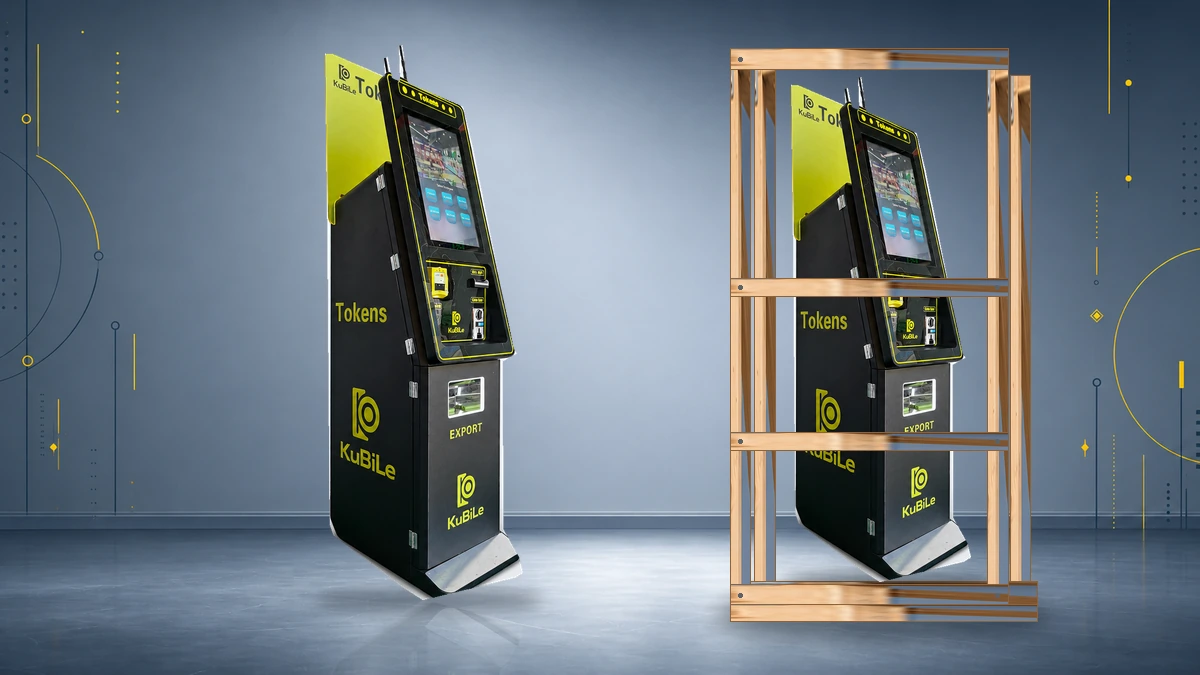
Packaging. Solid-wood crates must be heat-treated or fumigated and carry the ISPM 15 mark. Plywood is exempt. Kubile ships machines in wooden frames; ask for packed size and gross weight when you book freight.
Air or sea. Air freight is charged on the greater of actual weight and volumetric weight (length × width × height in cm ÷ 6,000). Large token machines usually go by sea; a single countertop unit may make sense by air.
After Delivery: Spare Parts, Updates and Support
Plan for the first year before the machines arrive.
- Spare parts kit: hopper, coin acceptor, power supply, locks and keys are common items. With Kubile, spare parts are optional; list the ones you want on the PI.
- Software and currency updates: how they’re delivered and who pays.
- Support channel: who to contact, in which time zone, and response time.
Work with Kubile
Kubile is a brand of Guangzhou Maizuo Cultural Development Co., Ltd., a manufacturer of token vending machines, self-service kiosks, token counting machines and ticket deposit machines in Guangzhou, China. Send us your destination market, currency, token samples and quantity, and we’ll confirm a configuration and quote. Contact our sales team.
FAQ
Can a token changer from China accept my local currency?
Yes, if the bill acceptor is configured for your currency before production. Tell the factory the currency and denominations at the start and check them on the PI.
Which bill acceptor brands can be fitted?
It depends on the factory and the model. Kubile uses BTC-brand acceptors as standard and configures them for the buyer’s currency.
What is the MOQ for a custom-branded token machine?
Kubile’s minimum order is one unit. For customized machines, confirm the MOQ for your options when you request a quote.
How long does production and shipping take?
Kubile’s production lead time is 7–28 days, depending on the order. Sea freight time depends on the destination port; ask your forwarder for the route.
Which certifications do I need?
It depends on the market: typically CE for the EU, UKCA or CE for the UK, FCC for the US, EESS/RCM for Australia and SABER for Saudi Arabia. Confirm with your importer.
What HS code is used for token changer machines?
They are commonly classified under heading 8476 as money-changing machines. Confirm the exact code with your customs broker.
How do I inspect the machines before paying the balance?
Ask for per-unit test videos against the checklist above, or hire a third-party inspection company to visit the factory before shipment.