
Self-Service Kiosk vs Cashier Counter: Staffing and Peak-Hour Planning for FECs
By Marketing Team
A self-service kiosk rarely replaces a cashier counter in a family entertainment center (FEC). It works best alongside one. Kiosks take over the high-volume, repeatable transactions such as new game cards, top-ups and token purchases, so your counter staff can handle the transactions that need a person. The right mix depends on how many transactions arrive in your busiest hour, and you can work it out with a simple calculation.
This guide gives you that calculation, the labor numbers behind it, and a list of what a staffed counter still has to do. If you need the basics of how a kiosk transaction works, start with our arcade self-serve kiosk buying guide.
The Short Answer: When a Kiosk Beats a Cashier
Kiosks win on speed of repeatable transactions and capacity at peak. Cashiers win on anything that needs judgment, flexibility or a conversation.
| Transaction | Kiosk | Staffed counter |
|---|---|---|
| Buy a new game card | ✓ | ✓ |
| Top up an existing card | ✓ | ✓ |
| Buy tokens with cash | ✓ (token vending machine) | ✓ |
| Party or group bookings | ✓ | |
| Refunds, disputes, lost cards | ✓ | |
| Guests who need help or a recommendation | ✓ |
Large operators work this way. Dave & Buster’s, for example, states in its annual report that guests buy game cards “at an automated kiosk, through our mobile application, or from one of our team members.” The kiosk is one channel, not the only one.
What Happens at an FEC Counter During Peak Hours
At peak, most of the queue at an FEC counter is made up of simple, repeatable transactions. Those are exactly the ones a kiosk can take.
Watch your counter on a busy Saturday afternoon and sort what you see:
- New cards and first purchases: routine, mostly the same steps every time.
- Top-ups: routine, and often the largest share of transactions.
- Token purchases in token-based venues: routine.
- Party check-ins, group packages, membership questions: need a person.
- Problems: a card that won’t read, a refund request, a complaint.
When the routine transactions move to kiosks, the queue gets shorter for everyone, including the guests who still need the counter.
The Labor Math: What One Cashier Hour Really Costs
Labor is one of the largest costs in an FEC, so the value of a kiosk shows up mostly in staff hours.
Some reference points from the US:
- Dave & Buster’s reported operating payroll and benefits at 23.9% of total revenue in fiscal 2023 (Form 10-K).
- The US Bureau of Labor Statistics put the mean hourly wage for amusement and recreation attendants in amusement parks and arcades at $14.52 (May 2023).
- The federal minimum wage is $7.25, but many states are far higher: $16.90 in California and $17.13 in Washington, according to the US Department of Labor’s state table (updated July 2026).
- Staffing is also hard to keep stable. Monthly quit rates in arts, entertainment and recreation ran between 1.5% and 3.0% through 2025 (BLS JOLTS data via FRED).
To find your real cost per cashier hour, take the hourly wage and add your employer costs (payroll taxes, insurance, benefits):
Loaded hourly cost = hourly wage × (1 + employer cost %)
Kiosk vs Counter Throughput: Measure It, Don’t Guess It
There’s no reliable public benchmark for how many seconds a transaction takes at a kiosk versus a counter, so measure your own.
It takes one busy afternoon:
- Time 20 transactions at your counter with a stopwatch, from “next, please” to the guest walking away.
- Do the same at a kiosk, or ask your kiosk supplier for measured times.
- Use the averages in the worksheet below.
On Kubile’s MZ-160 Card Vending Machine, the card comes out, or the top-up is applied, as soon as the guest finishes selecting and paying. In practice, kiosk transaction time is mostly the guest’s own time on the screen, so a clear interface matters more than machine speed.
One planning rule matters more than the exact seconds: don’t plan any station at 100% use. Queues grow quickly as a station approaches full capacity, so plan for about 75–80%.
Peak-Hour Planning Worksheet: How Many Kiosks and How Many Cashiers
Use your busiest hour of the week. If your venue works at peak, it works the rest of the time.
Inputs
| Symbol | What it means | Where to get it |
|---|---|---|
| G | Groups arriving in your busiest hour | POS or entry reports |
| p | Share of groups that make a front-desk transaction | POS reports |
| Tc | Average counter transaction time (seconds) | Your stopwatch test |
| Tk | Average kiosk transaction time (seconds) | Your test or supplier data |
| a | Share of transactions you expect to move to kiosks | Start with a pilot estimate |
| ρ | Target utilization (0.75–0.80) | Planning rule |
Formulas (Kubile kiosk staffing formula)
Peak transactions          N  = G × p
Per cashier per hour       Cc = 3600 ÷ Tc × ρ
Per kiosk per hour         Ck = 3600 ÷ Tk × ρ
Kiosks needed              K  = round up (N × a ÷ Ck)
Cashiers needed            S  = round up (N × (1 − a) ÷ Cc), minimum 1
Kiosk-area attendants      A  = round up (K ÷ 4)
Cashiers without kiosks    S0 = round up (N ÷ Cc)
Worked example (illustrative numbers, not benchmarks)
An FEC sees 200 groups in its peak hour, and 70% of them make a front-desk transaction, so N = 140. A counter transaction takes 60 seconds and a kiosk transaction 90 seconds. At 80% utilization, one cashier handles 48 transactions an hour and one kiosk handles 32.
- Without kiosks: 140 ÷ 48 → 3 cashiers
- With kiosks taking 60% of transactions: 84 ÷ 32 → 3 kiosks, 56 ÷ 48 → 2 cashiers, plus 1 attendant for the kiosk area
Peak headcount stays at three, but the venue can now handle 192 transactions an hour instead of 144, about a third more capacity, without hiring. When a busy holiday weekend arrives, the kiosks absorb the extra demand instead of the queue.
This is the main point of the calculation: at peak, a kiosk’s biggest value is extra capacity that doesn’t need a new hire. Savings in staff hours come mostly from quieter hours and from growth you no longer have to staff for.
Transactions That Still Need a Staffed Counter
Keep at least one staffed counter open whenever you’re busy, because some transactions can’t be automated well:
- Birthday parties, group packages and corporate events
- Refunds, disputes and complaints
- Lost, damaged or unreadable cards
- Large-note cash and change requests
- Membership sign-ups or upgrades that need ID checks
- Guests who need help: first-time visitors, older guests, families with questions
- The prize redemption counter, if it isn’t handled separately
Redeploy Staff Instead of Cutting Them
Many operators get more value from moving a cashier onto the floor than from removing the position.
A kiosk bank works best with a nearby attendant who helps first-time users, clears problems and suggests top-ups. One FEC case study published by a card-system vendor reports a ratio of one staff member to four kiosks; treat that as a starting point, not a rule. The attendant role also helps with retention, since it’s less repetitive than standing behind a register.
What Kiosks Change in Guest Spend
There is some evidence that guests spend more at kiosks, but most of it comes from vendors or other industries, so treat it as a direction rather than a promise.
- A card-system vendor reports that customers see 50–70% of total sales come through its kiosks (vendor claim).
- A study by the University of Hamburg of 20 fast-food restaurants found guests spent on average 14–16% more at kiosks than at the counter, partly because upsells were offered consistently. That is restaurant data, not FEC data.
Your own pilot will tell you more than any of these figures.
Token Venues: The Same Logic Applies
If your venue runs on tokens instead of cards, a token vending machine is your kiosk.
The same worksheet works: replace “new card or top-up” with “token purchase,” time your token counter, and size the number of token machines the same way. Behind the scenes, counting the collected tokens moves from hand counting to a token counting machine, and a token deposit machine lets guests deposit leftover tokens without a staff member. Our guide on how to choose a token changer covers the machine side in more detail.
Placement: Where Kiosks and the Counter Should Sit
Put kiosks where guests meet them first, and the counter where guests go when they need help.
- Place the kiosk bank between the entrance and the counter, so routine buyers peel off before the queue forms.
- Keep the counter visible, so guests with questions can find it.
- Leave room for a short queue at each kiosk without blocking the game floor.
For power, network and installation details, see the buying guide.
A Rollout Plan: Pilot, Measure, Then Scale
Start small and let your numbers decide.
- Pilot one or two kiosks for 4–8 weeks.
- Track peak queue length, share of transactions through kiosks, staff hours per $1,000 of revenue, and kiosk downtime.
- Re-run the worksheet with your measured numbers.
- Scale to the kiosk count your peak hour actually needs.
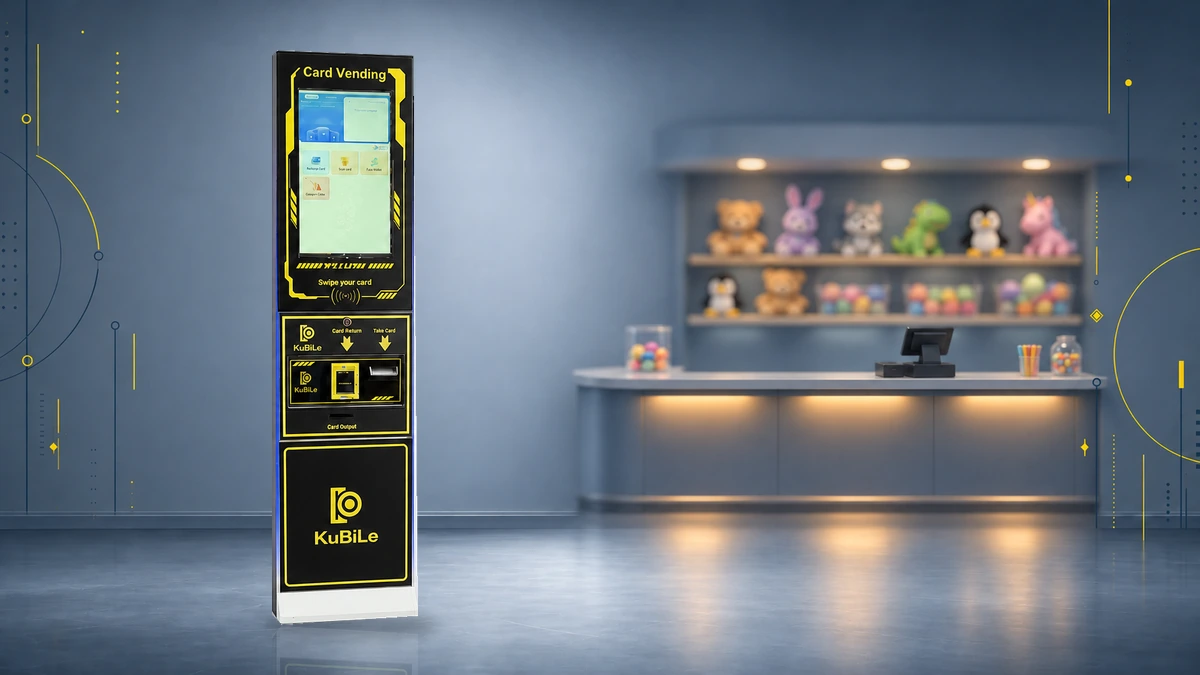
Kubile’s MZ-160 Card Vending Machine sells new chip cards and tops up existing ones, with a 22-inch touchscreen and bill acceptor, and runs on 110–240 V. If you send us your peak-hour numbers, we’ll help you size a kiosk setup. Contact our sales team.
FAQ
How many self-service kiosks does a family entertainment center need?
It depends on your peak-hour transactions, not your floor size. Divide the transactions you expect kiosks to handle in your busiest hour by what one kiosk can process at about 80% utilization, then round up.
Can a self-service kiosk replace a cashier completely?
Usually not. Parties, refunds, lost cards and guests who need help still need a person. Most venues keep at least one staffed counter at busy times.
How many kiosks can one staff member supervise?
One published FEC case reports one attendant for every four kiosks. Use it as a starting point and adjust after a pilot.
Do guests spend more at a kiosk than at a counter?
Vendor reports and restaurant research suggest they can, mainly because upsells are offered every time. Measure it in your own venue before counting on it.
How does a self-service kiosk work in a family entertainment center?
A guest chooses a new card or top-up, pays by cash or card, and the kiosk issues or loads the game card. Our buying guide walks through each step.
Are self-service kiosks used in amusement parks and theme parks too?
Yes. The same peak-hour logic applies to ticketing and stored-value cards in larger parks.
Do kiosks work in token-based arcades?
Yes. In a token venue, a token vending machine plays the kiosk’s role, and the same worksheet sizes how many you need.