
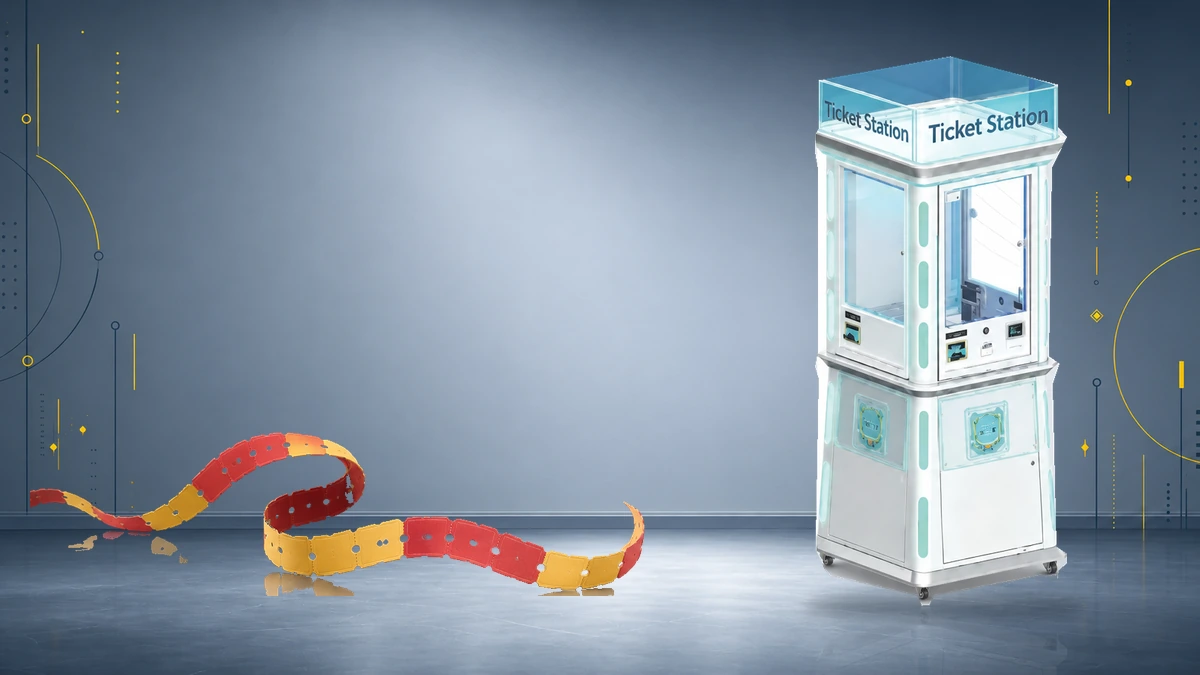
Arcade Ticket Deposit Machines (Ticket Eaters): Paper Tickets vs E-Tickets
By Marketing Team
Choosing between paper tickets and e-tickets doesn’t have to be all-or-nothing. Many arcades and family entertainment centers keep paper tickets on the game floor, where players enjoy them, and use a ticket deposit machine to count them and print a receipt that players redeem at the prize counter. This guide compares the three options (paper, e-tickets and the hybrid route) and explains where a ticket deposit machine fits in each.
What Is an Arcade Ticket Deposit Machine?
An arcade ticket deposit machine, also called a ticket eater, ticket muncher or ticket counter, is a machine that counts players’ redemption tickets, destroys or stores them, and gives the player a record of the total.
Instead of handing a pile of tickets to staff at the prize counter, the player feeds them into the machine. The machine counts each ticket, then prints a receipt or credits the total to the player’s account, depending on how it’s set up. The player takes that total to the prize counter.
Kubile’s arcade ticket deposit machines come in three formats: a three-station upright, a single upright and a countertop unit.
How a Ticket Eater Counts Tickets
A ticket eater counts by detecting each ticket as it passes a sensor, usually by reading the notches or perforations between tickets, then cuts or stores the tickets so they can’t be reused.
Most machines also keep an internal counter that records the total over the machine’s life, which helps with auditing. Published speeds for single-station machines in the US market are typically 10–13 tickets per second, or about 600–780 per minute. Kubile’s MZ-200 counts 900 full-size tickets or 1,800 half-size tickets per minute at each of its three stations.
The standard redemption ticket is 2″ × 1 5/32″ (about 50.6 × 29.2 mm), and most ticket eaters are built around that size.
Paper Tickets: What They Still Do Well
Paper tickets survive in so many venues because players, especially children, love them.
- The payout moment. A stream of tickets coming out of a game is part of the fun. A number on a screen doesn’t feel the same.
- Collecting. Kids like holding and counting a growing pile of tickets.
- Older games work as they are. Every ticket-dispensing game on your floor works without changes.
Industry voices haven’t settled the question. White Hutchinson Leisure & Learning Group, a leisure consultancy, argued in 2017 that going ticketless could cut redemption game revenue, citing one operator’s preliminary test that pointed to losses of 20% or more. That’s a single, unpublished test, but it shows why many operators move carefully.
The Hidden Costs of Paper Tickets
Paper tickets carry costs that don’t show up on the ticket invoice.
- Consumables. Ticket stock, plus receipt paper if you use printed receipts.
- Handling. Without a counting machine, staff count or weigh tickets by hand at the prize counter, often at the busiest time.
- Leakage. Tickets can be taken home, brought back from another visit or counterfeited. Every unredeemed ticket is a prize you still owe.
- Storage and disposal. Tickets take up space before and after use.
The scale can surprise you. When Chuck E. Cheese went through bankruptcy in 2020, it asked the court for permission to destroy about 7 billion paper prize tickets, enough to fill about 65 shipping containers, at an estimated cost of around $2.3 million. The company now credits tickets straight to players’ Play Pass cards.
E-Tickets on Game Cards: How They Work
With e-tickets, each game adds tickets directly to the player’s game card instead of printing paper.
The player swipes or taps their card on the game, plays, and the tickets won are credited to the card balance. At the prize counter, staff deduct the balance. There’s no paper to dispense, count or destroy.
Large venues have made the switch. Universal Orlando moved its arcades to e-tickets in 2021, replacing ticket outlets on the games with card readers.
The Trade-offs of Going Ticketless
E-tickets remove paper costs but introduce others.
- System investment. Every game needs a card reader, and you need a card system, cards and point-of-sale integration.
- Retrofitting. Older ticket games have to be converted, one by one.
- Guest experience. Younger players may not understand a number on a card the way they understand a pile of tickets.
- Revenue risk. As noted above, some operators worry that losing the paper payout moment reduces play.
E-tickets usually make the most sense for chains and large venues that already run a card system. If you need to issue and top up game cards, see our card vending machine and kiosk buying guide.
Paper vs E-Tickets vs Hybrid: Side-by-Side
| Paper tickets + ticket eater | E-tickets on cards | Hybrid: paper on the floor, counted at the deposit machine | |
|---|---|---|---|
| Upfront cost | Low to moderate | High (readers on every game, card system) | Moderate |
| Ongoing consumables | Ticket stock, receipt paper | Cards | Ticket stock |
| Staff time at prize counter | Low with a ticket eater | Lowest | Low |
| Leakage and fraud | Higher; barcoded receipts help | Lowest; every balance traceable | Lower than paper alone |
| Player experience | Physical payout, great for kids | Convenient, less tactile | Keeps the physical payout |
| Older ticket games | Work as they are | Each needs conversion | Work as they are |
| Reporting | Basic | Complete | Moderate to good |
| Best for | Smaller arcades, younger audiences | Chains, venues with card systems | Most mid-size FECs and venues in transition |
For reference, published US retail prices for ticket eaters range from roughly $900 for a basic countertop unit to around $5,900 for a three-station upright. Factory-direct pricing depends on configuration.
The Hybrid Route: Keep Paper on the Floor, Count at the Deposit Machine
The hybrid route keeps what players love about paper tickets and takes ticket counting off your prize counter.
Players win and collect paper tickets as usual. When they’re done, they feed the tickets into a ticket deposit machine, which counts and destroys them and prints a receipt with the total. The player brings one receipt, not a pile of paper, to the prize counter.
What this gives you:
- No changes to your existing ticket games
- Tickets are counted and destroyed in one place, not at the prize counter
- Staff redeem a single receipt instead of counting tickets by hand
- You keep the option of moving to e-tickets later, without converting your whole floor at once
Kubile’s ticket deposit machines count tickets and print receipts; they don’t credit tickets to game cards. If you need the machine to work with an existing system in your venue, our technical team can discuss integration for your project.
Ticket Eater Specs That Matter
When comparing ticket deposit machines, check these:
- Counting speed, and whether the figure is per station or for the whole machine.
- Number of stations. More stations shorten the queue at busy times.
- Ticket compatibility. Full-size and half-size tickets, plus any barcoded tickets you use. Kubile’s machines handle both full and half tickets. If you use barcoded tickets, ask whether the machine reads them.
- Jam handling. How the machine clears a crumpled or wet ticket.
- Output. A printed receipt (what it shows, whether it has a barcode or QR code), or card credit on systems that offer it.
- Bin capacity and a full-bin warning.
- Voltage and size. All Kubile ticket deposit machines run on 110–240 V.
Countertop, Upright or Multi-Station?
| Model | Format | Display / output | Size (W × D × H) | Best for |
|---|---|---|---|---|
| MZ-MINI Ticket Machine | Countertop | 7″ touch screen, thermal printer | 43 × 40 × 32 cm, 25 kg | Small arcades, counters with limited space |
| MZ-LS Ticket Machine | Single upright | 7″ touch screen, thermal printer | 43 × 40 × 107 cm, 40 kg | Mid-size venues, a dedicated deposit point |
| MZ-200 Ticket Station | Three-station upright | LED display, thermal printer | 75 × 75 × 200 cm, 100 kg | Busy FECs where several players deposit at once |
If your venue runs on tokens, the same idea applies to leftover tokens: a token deposit machine lets players deposit tokens without staff, and a token counting machine handles the back-office count.
Not sure which setup fits your floor? Tell us about your venue and how you run redemption today.
FAQ
What is a ticket eater at an arcade?
A ticket eater is a machine that counts players’ redemption tickets, destroys or stores them, and gives the player a receipt or card credit for the total, which they take to the prize counter.
How fast does a ticket eater count tickets?
Published speeds for single-station machines are typically 10–13 tickets per second (about 600–780 per minute). Kubile’s MZ-200 counts 900 full-size or 1,800 half-size tickets per minute at each station. Multi-station machines let several players deposit at the same time.
Can a ticket eater put tickets onto a game card?
Some systems do. Kubile’s ticket deposit machines print a receipt with the total instead, which the player redeems at the prize counter. That keeps paper tickets on your floor without needing a card system.
Are e-tickets better than paper tickets for an FEC?
It depends on your venue. E-tickets reduce paper handling and leakage but require a card system and readers on every game. Paper keeps the physical payout players enjoy. A hybrid setup gives you some of both.
Why did some arcades stop using paper tickets?
Mainly cost, handling and leakage. Chuck E. Cheese, for example, moved tickets onto its Play Pass cards after asking to destroy about 7 billion paper tickets in 2020.
How much does a ticket eater cost?
Published US retail prices range from about $900 for a basic countertop unit to around $5,900 for a three-station upright. Factory-direct pricing depends on the model and configuration.
Is an arcade “ticket vending machine” the same as a transit ticket machine?
No. In arcades, “ticket” usually means redemption tickets won from games. Transit and parking ticket machines are a different product. Kubile’s MZ-160 Ticket Vending Machine is also a different product: a self-service kiosk that sells admission tickets for scenic areas, amusement parks and FECs. It doesn’t handle redemption tickets.