
Token Counting Machines for Arcades: Desktop vs High-Capacity, How to Choose
By Marketing Team
The right token counting machine for an arcade is the one that fits how many tokens you collect at a time, the size of your tokens, and how you reconcile counts against revenue. Counting speed on a spec sheet matters far less than most buyers expect. This guide walks through each factor and ends with a simple way to decide between a compact desktop counter and a higher-capacity model.
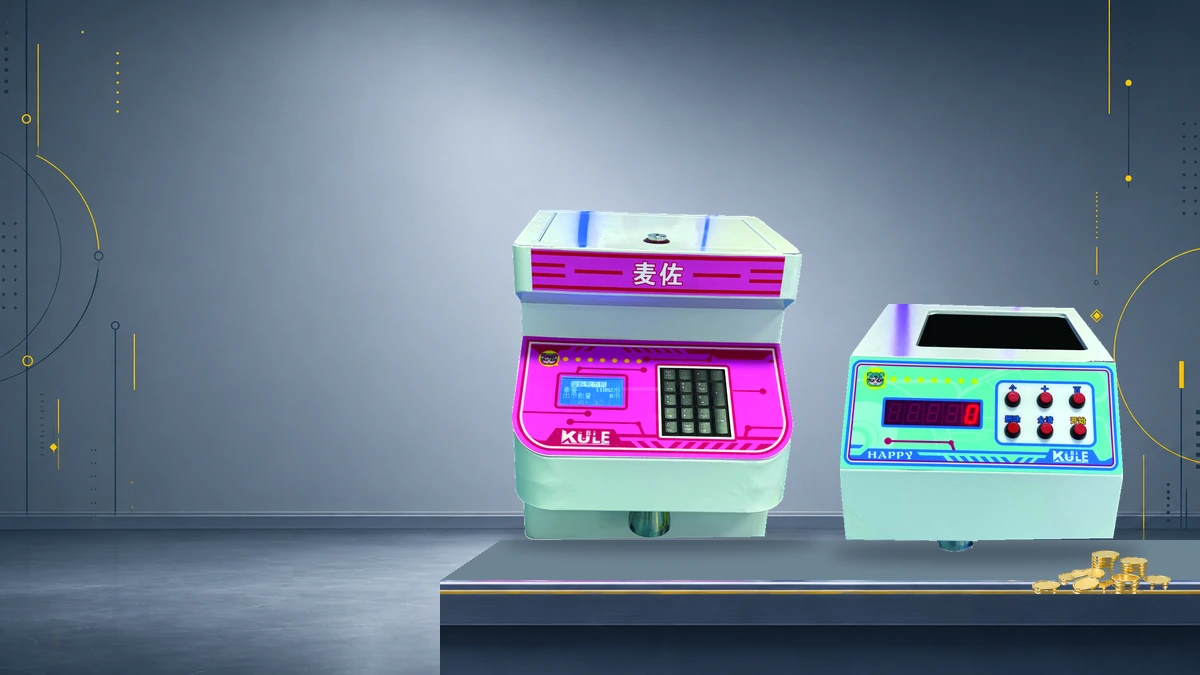
Kubile is a manufacturer of token vending machines, token counting machines and self-service equipment for arcades and family entertainment centers. The two counters referenced in this guide are our Token Counter and Token Counter B.
What a Token Counting Machine Does in an Arcade
A token counting machine turns a bucket of loose tokens into a verified number you can record, so your back office knows exactly how many tokens came out of the games before they go back into circulation.
In practice, it sits between two steps of your token cycle: collection from game cabinets and refilling your token vending machines. Staff pour collected tokens into the hopper, the machine counts them, and the total gets written down or entered into your records.
What it does not do: it doesn’t tell you which game earned the tokens (that’s what cabinet meters and audit counters are for), and it doesn’t replace a ticket counter. Redemption tickets need their own machine, such as an arcade ticket deposit machine.
Where Token Counting Fits in Your Daily Workflow
Token counting is the checkpoint between collection and refill. It is where you confirm that what went into the games matches what you expected.
A typical cycle looks like this:
- Collect tokens from game cabinets at the end of a shift or day.
- Count them in the back office.
- Reconcile the count against meter readings, token sales and expected revenue.
- Refill token vending machines and counter stock with the counted tokens.
Arcade operators have long used cabinet meters for the per-game view, because reading a meter is faster than counting coins by hand. A counting machine adds the venue-level total. Together they let you spot gaps: if meters say one number and the counted total says another, something needs checking.
Counting Machine, Weighing Scale or Meter Readings?
For most arcades, a piece-counting machine is the best primary method, a scale is a quick estimate, and meters are a per-game cross-check.
| Method | How it works | Best for | Limitation |
|---|---|---|---|
| Token counting machine | Counts each token individually | Exact totals for reconciliation and refills | Needs a hopper and token size it can handle |
| Weighing scale | Estimates count from total weight | Fast estimates, mixed bulk handling | Worn, dirty or mixed tokens skew the weight |
| Cabinet meters | Record coins/tokens inserted per game | Per-game performance and spotting skimming | Doesn’t count what’s physically in your back office |
Desktop vs High-Capacity: The Real Difference Is Hopper Size
The main difference between a compact desktop counter and a high-capacity counter is how many tokens you can load at once, not how fast it counts.
Both Kubile counters are tabletop machines that count at the same rated speed of 650 tokens per minute. What changes is the hopper and the display:
| Token Counter B (compact) | Token Counter (high-capacity) | |
|---|---|---|
| Hopper capacity | 2,500 tokens | 5,000 tokens |
| Counting rate | 650 pcs/min | 650 pcs/min |
| Display | LED display | 4.3-inch display |
| Dimensions (W × D × H) | 29 × 36 × 27 cm | 29 × 39 × 36 cm |
| Weight | 10 kg | 12.5 kg |
| Power / voltage | 25 W · 110–240 V | 25 W · 110–240 V |
Hopper size matters because every time the hopper fills, a staff member has to stop, empty and reload. A useful reference point: token dispensers commonly hold anywhere from about 2,800 to 6,400 tokens. If you’re counting a full refill’s worth of tokens in one go, a 5,000-token hopper lets you do it with fewer interruptions.
How to Read Speed Claims
“Coins per minute” figures are not directly comparable to tokens per minute, so don’t choose a counter on headline speed alone.
Many general-purpose coin counters advertise 2,000 to 2,300 pieces per minute, and some manufacturers state that the figure is measured with dimes, a small, thin US coin. Arcade tokens are usually larger and thicker, and larger pieces pass through a counting mechanism more slowly.
When comparing machines, ask every supplier the same question: what is the counting rate with my tokens? Send a sample bag if you can. Kubile’s counters are rated at 650 pcs/min across their full accepted token range, from 22 mm to 30 mm, so the speed you plan around doesn’t change with your token size.
For a sense of scale, even at 650 per minute a full 5,000-token hopper counts in under eight minutes.
Match the Machine to Your Tokens
A counter that can’t handle your token’s diameter and thickness is the wrong counter, whatever else it offers.
Arcade tokens vary widely. A commonly used US token dispenser accepts tokens from 3/4″ to 1 1/8″ (about 19–28.6 mm) in diameter, and token makers offer custom tokens from roughly 21 to 40 mm. Check three things:
- Diameter and thickness range the counter accepts. Kubile’s Token Counter and Token Counter B accept tokens from 22 to 30 mm in diameter and 1.6 to 3.2 mm thick.
- Worn and dirty tokens. Tokens that have circulated for years get thinner and grimier. Ask how the machine handles them and how it clears a jam. Kubile’s counters rarely jam with tokens alone; jams usually come from debris mixed in with the tokens, such as tickets, wrappers or small objects, so a quick check before pouring prevents most of them.
- Mixed tokens. If your venue has used more than one token design, or customers sometimes drop in foreign coins, ask whether the machine rejects pieces outside the set size. Kubile’s counters count every piece that fits the 22–30 mm range and don’t sort out foreign coins, so pick out stray coins before counting. If you need automatic rejection, a counter with off-sorting is the better fit.
Features That Matter for Reconciliation
The features worth paying for are the ones that make your count easy to record and check.
- Clear display. Staff should be able to read and write down the total without ambiguity. The high-capacity Token Counter uses a 4.3-inch display; Token Counter B uses an LED display.
- Batching. Stops at a preset number so you can bag tokens in fixed quantities for refills.
- Accumulation. Keeps a running total across several hopper loads.
- Data export. Exporting counts reduces copying errors.
Kubile’s Token Counter and Token Counter B support batching, accumulation and data export.
If a feature isn’t on the spec sheet, ask before you buy rather than assuming.
Power, Size and Placement
A token counter lives in your back office, so check voltage, footprint and weight before it ships.
Both Kubile counters run on 110–240 V at 25 W, which means one model works in North America, Europe, Southeast Asia and the Middle East without a voltage-specific version. At 29 cm wide and 10–12.5 kg, they fit on a standard desk or counting table.
Quick Decision Guide
| Your situation | Recommended |
|---|---|
| Small arcade or kiosk-style venue, smaller daily collections, limited desk space | Token Counter B (2,500-token hopper) |
| Mid-size or busy arcade, counting full refill batches, fewer reloads wanted | Token Counter (5,000-token hopper) |
| Multiple counting points or very high volume | Several units, sized to your collection points; ask us for a recommendation |
Questions to Ask Any Token Counter Supplier
Before you order, get written answers to these:
- What is the counting rate with my token size?
- What diameter and thickness range does it accept, and is it adjustable?
- How does it handle worn, dirty or foreign tokens, and how do I clear a jam?
- Does it support batching and accumulation?
- Can counts be printed or exported?
- What voltage does it run on?
- What is the warranty, and which parts wear out first?
- What is the lead time and shipping size?
If you’d like these answered for Kubile’s counters, or want a recommendation based on your token size and daily volume, contact our sales team.
FAQ
Can a regular coin counter count arcade tokens?
Often yes, as long as your tokens fall within the counter’s diameter and thickness range. Check the range against your token before buying, and ask for the counting rate with tokens rather than coins.
How fast does a token counting machine count?
Kubile’s Token Counter and Token Counter B are rated at 650 tokens per minute. Many general coin counters advertise 2,000+ pieces per minute, but those figures are often measured with small coins, so they aren’t directly comparable.
What size tokens can Kubile’s token counters handle?
Tokens from 22 to 30 mm in diameter and 1.6 to 3.2 mm thick, at the same 650 tokens per minute across that range.
How many tokens can a token counter hold at once?
Kubile’s Token Counter B holds 2,500 tokens and the Token Counter holds 5,000. For comparison, token dispensers commonly hold about 2,800 to 6,400 tokens.
Should I count tokens by weight or by piece?
Counting by piece gives an exact total, which is what you want for reconciliation. Weighing is faster for rough estimates but becomes less accurate as tokens wear or get mixed.
Do I need a desktop or high-capacity token counter?
Choose by how many tokens you count in one session. If you regularly count more than about 2,500 at a time, a 5,000-token hopper saves reloading time.
Does a token counter work on both 110 V and 220 V?
Kubile’s counters accept 110–240 V, so the same model works in most markets.
How do arcades keep token counts accurate?
By comparing three numbers: cabinet meter readings, the counted total from the back office, and token sales. A mismatch between them is the signal to investigate.